

Most tech projects don't fail because
the technology is hard.
They fail because the fundamentals get skipped —
and nobody notices until it's too late.
Whether you're figuring out
where AI fits in your business, or
you've got a project on your plate and
need to deliver it —
there's a simple place to start.
Where do you want to start?
For Organizations
Find the right AI opportunities before you build the wrong thing.
Introducing the AI Value Framework™
A practical opportunity-to-outcome approach for identifying, validating, and delivering AI solutions that create measurable business value
-
How it Works
Most organizations approach AI from the inside out — starting with what they have, then looking for places to apply it.
The better question is what your customers actually need, and whether AI can close that gap.
AI Discovery and the Three Horizons framework gives your leadership team a structured way to find the real opportunities.
Then rank them by customer impact and feasibility, and walk away with something you can actually act on.
-
What you get:
Three facilitated sessions that shift your team from inside-out to outside-in thinking
A customer value statement that defines the real problem worth solving
A process map flagged with AI opportunities
A prioritized list ranked by customer impact and feasibility
For Managers
You've got a tech project on your plate. Here's a simple way to run it.
Introducing the MPM Framework™
A clear, repeatable, direct, simplified project delivery structure — no heavy methodology, no PMP required.
-
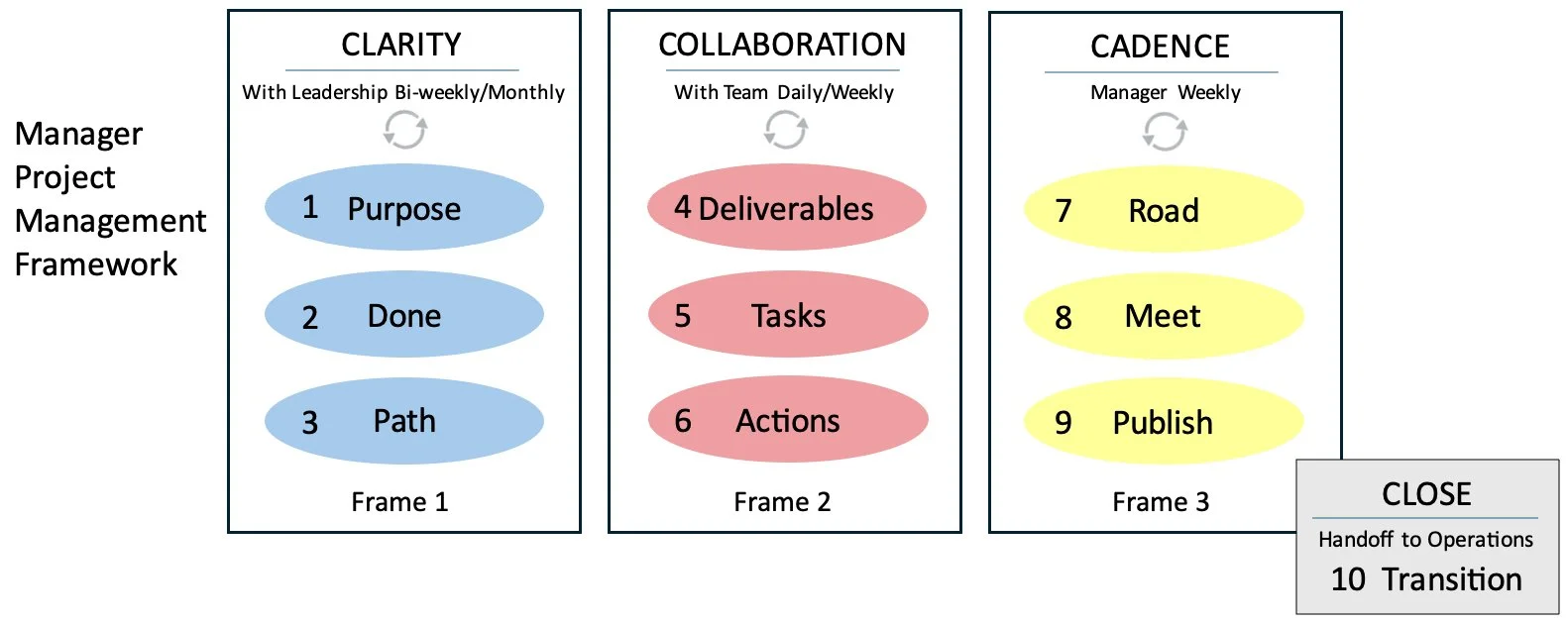
CLARITY with the leadership, bi-weekly or monthly:
Purpose – Why are we doing this project in a couple of simple statements.
Done – What does “done” look like to all stakeholder leaders for the project?
Path – What are the handful of high-level steps that will gauge if the project is on track?
-
COLLABORATION with the team, daily or weekly:
Deliverables – What are the deliverables for each step, and is there feedback to the leadership?
Tasks – What are the tasks to achieve the deliverables?
Actions – Who is doing what and when?
-
CADENCE as the manager, weekly, bi-weekly, monthly:
Road – What does the road ahead look like? Is it clear? What are the blockers that need attention?
Meet – Meet with the project team on progress on actions and the leadership regarding the path.
Publish – Communicate to teams and leadership on achievements, next steps, issues and risks.
-
CLOSE as the manager, at the end:
Transition – When the project is done, close it, and transition responsibilities to operations.
That’s it.
That’s the promise for your challenges.
-
Many managers are asked to lead data and AI tech projects on top of their operational responsibilities.
Running a tech project is different than operations and so needs to be managed differently.
First you get clarity with leadership. Then you engage the team. Then you run a simple weekly rhythm. And eventually, you close cleanly.
-
Managers are accountable for project outcomes, timelines, and decisions — often without formal project management training or additional time.
Understand the simple steps to get CLARITY with the leadership. Then engage the team through COLLABORATION. Then develop a CADENCE with a simple weekly rhythm. And eventually, TRANSITION and CLOSE cleanly.
-
This site is for managers who want a simpler, calmer way to get tech projects moving and keep them on track.
The three-frame framework of CLARITY - COLLABORATION - CADENCE is memorable, operational, and repeatable. It mirrors how a busy manager actually thinks.
Most frameworks fail because they’re either academically elegant but unusable, or overly tactical without leadership grounding. This one aligns leadership clarity, team psychology, and weekly behavior.
That's why it feels like it fits and works like it should.




Why tech projects feel harder than they should.
Most tech projects don’t struggle because managers aren’t capable.
They struggle because important fundamentals are skipped in the rush to get started - often without anyone realizing it.
-
Describe the purpose like an elevator pitch, including for example, what things look like now and what problems that creates, or what challenges or problems are we currently facing that will this solve, or what opportunities does it provide?
Or, Top-line or bottom-line improvements?
-
No shared definition of success
Projects often begin with good intentions but unclear goals. Key supporters quietly have different ideas of “done,” causing rework, delays, and stalled decisions. Worse, those tough talks about what “done” means happen at the end instead of the start.
This isn’t a lack of effort — it happens when the team hasn’t agreed on what “done” looks like.
What does the actual project ‘finish’ line look like?
Does everyone in leadership support have the same idea of what "done” looks like when work stops?
-
What outcomes do we expect at what stage?
What are the key major milestones that everyone can gauge how we are doing?
What are the big steps to get to “done”?
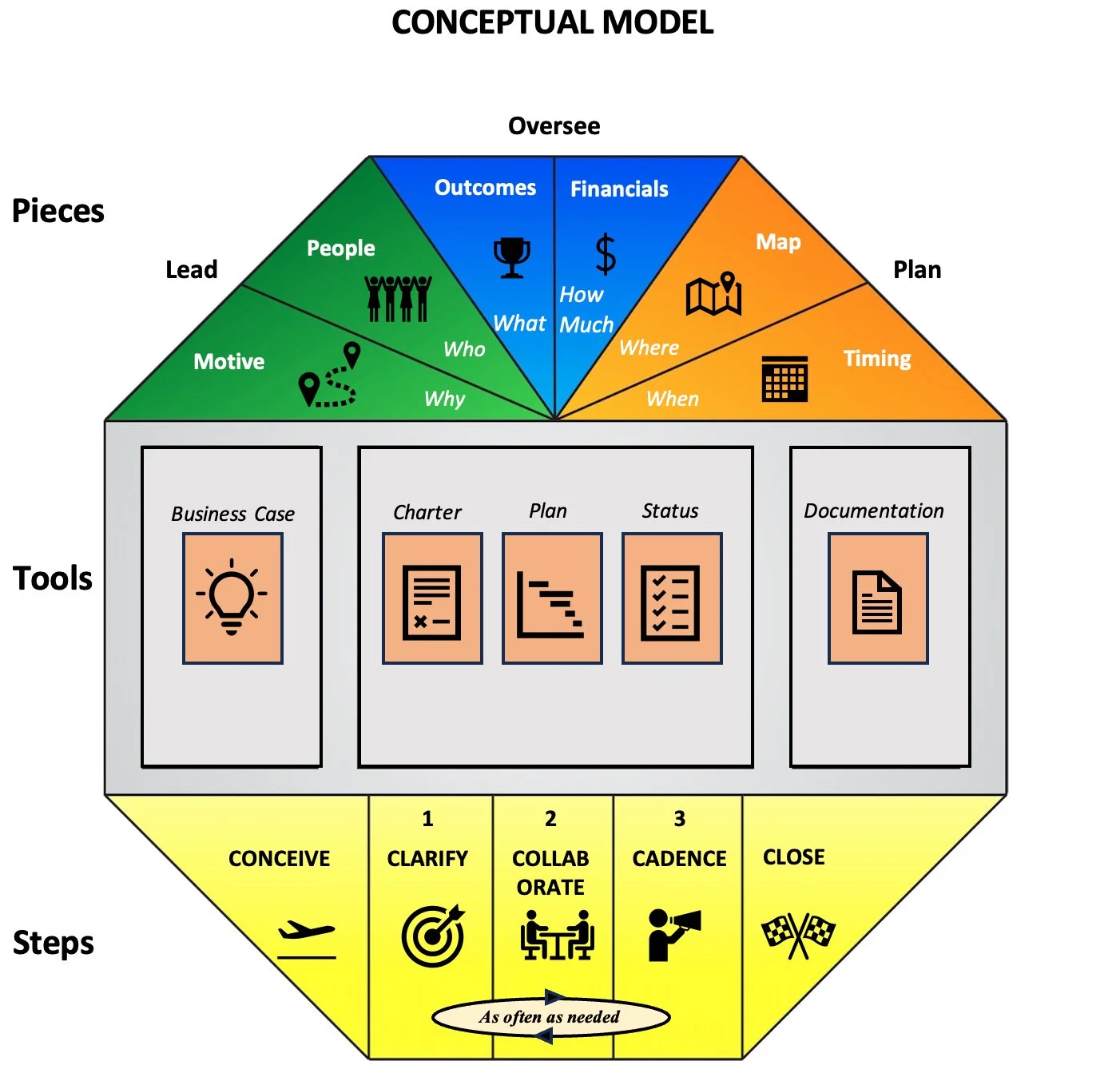
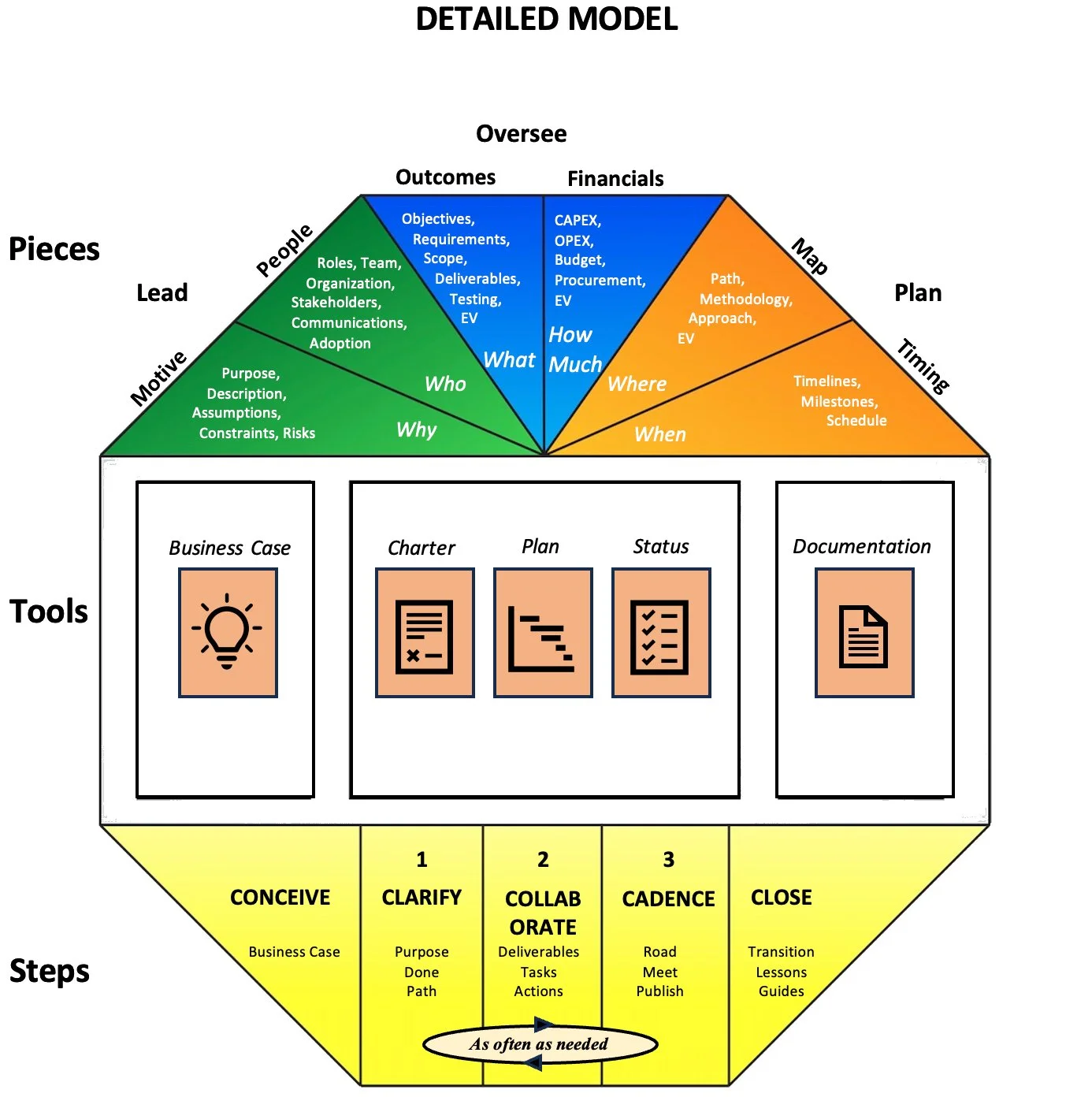
Manager Project Management
Approach




Project Examples
Project Clarity Pieces
What is the Purpose?
What does “Done” look like?
What is the Path to get there?
Example 1:
AI-Powered Customer Support Triage
Use AI to auto-classify incoming customer service tickets for faster response and routing.
1. Purpose?
Free up support staff from repetitive triage tasks
Reduce customer wait times
Improve service consistency for common requests
2. Done?
The AI categorizes 80% of incoming tickets accurately
Simple dashboard shows trends by issue type
Tickets are auto-assigned to the right teams
3. Path?
Month 1: Model trained on past tickets.
Month 2–3: Pilot in limited regions and/or product lines.
Month 4–5: Expanded to several teams, and some edge cases refined.
Example 2:
AI-Assisted Sales
Forecasting
Use AI to analyze past sales data and improve forecast accuracy for planning.
1. Purpose?
Identify patterns in sales cycles we can’t easily spot manually
Improve confidence in inventory or staffing decisions
Create alignment between finance, sales, and ops
2. Done?
Teams receive updated forecasts monthly, driven by AI
Leadership sees 20–30% increase in forecast accuracy
Clear visual reports explain why the model predicts what it does
3. Path?
Month 1: Alignment on data sources and key business inputs.
Month 2–3: Trained/tested forecast model on past data.
Month 4–5: Forecasts used in planning cycles, gathering feedback.
Example 3:
AI for Employee Onboarding Content Creation
Use generative AI to draft onboarding docs and job aids faster, with human oversight.
1. Purpose?
Save time for HR and managers creating repetitive content
Create more consistent onboarding experiences
Make materials easier to update regularly
2. Done?
10–15 onboarding assets drafted via AI, then finalized by staff
Managers can request job aids with simple prompts
Process includes human review before anything goes live
3. Path?
Month 1: Defined document types and tone-of-voice templates.
Month 2–3: Asset generation piloted with HR + team leads.
Month 4: System launched for 1–2 departments.
What actually helps managers
run projects.
As a manager, your tech projects don’t need heavy frameworks or complex tools.
They need a small set of high-impact simple habits that create clarity, collaboration, and a weekly cadence — without adding overhead.
-
Define success first.
Projects move faster when the leadership support knows the problem and what success looks like in plain terms.
No heavy docs - it can be done in a 1-pager - just a clear reference about the purpose, what “done” looks like, the high-level steps and timeframes.
At that point all the key players know and agree about where things are going.
-
Once there is clarity amongst the leadership about the purpose, end-state, high-level steps, then involve the team in a way that engages them and builds collaboration.
Deliverables: With the team, together define the deliverables that are possible for the outcomes at the key steps.
Activities: Collaborate with the team to decide on what tasks and actions are to be taken to complete the deliverables.
Review: Get opinions and input from each team members. Listen and ensure there is understanding regarding their perspective. This is powerful.
Revise: Each time the team meets whether weekly or multiple times per week, review and revise the deliverables and activities with the team to make sure the high-level steps can be achieved.
-
A simple, weekly, predictably rhythm beats big plans.
A lightweight weekly check-in and review creates more momentum than detailed plans that never get revisited.
Consistency matters more than complexity when projects compete with day-to-day operations.
Each week the manager needs to review the key pieces to the project plan, the status of where things are at, then review and revise with the team, and then communicate to the team and key stakeholders.




How I Work.
I work with managers the same way I’ve worked with executive teams and technical teams for decades.
Calmly. Practically.
Focused on what actually moves things forward.
The goal isn’t perfection.
It’s progress that feels manageable
There’s no one-size-fits-all framework — just a small set of proven steps applied thoughtfully to your context.
Also, extensive methodology experience allows adapting the organization’s comprehensive methodology into simpler but compliant form for a manager.
Choose a simple
place to start.
You don’t need to do everything at once.
Start where it feels most useful.
-
Field notes & short guides.
Practical observations and lightweight resources you can apply immediately - insights you won’t get from AI.
Links coming on or before the end of Feb 2026
-
Courses & routines.
A manager project quick start guide on CLARITY with downloadable fast launch materials.
A manager guided learning focused on how to get COLLABORATION, essentially building a high-performing team that operates without you, and a set of weekly habits to follow for a simple repeatable CADENCE.
Coming in April 2026.
-
Advisory & coaching.
Ongoing or time-bound support for managers running real projects.
PROJECT LEADERSHIP LAB - 6 month engagement - small cohort - no more than 6 participants.
No open slots at this time until May 2026.
EXECUTIVE PARTNERING PROGRAM - 6 month engagement - 1 on 1 - direct, custom guidance to guarantee success with minimal effort and very efficient learning.
Why
This Approach Works.
I’ve spent decades leading and recovering complex data and AI tech projects across business and technology environments.
But more importantly, I’ve worked closely with managers and directors balancing operational responsibility with project accountability.
I’ve held roles as a senior director in Fortune 500 companies in both the US and Canada, where I also managed tech projects on the side; so I’ve been there, done that, got the t-shirt, and so know how to deliver within those constraints.
This work is about making your leadership life simpler — not more complicated.
You don’t need more theory.
You need clarity and a way forward.
If you’re managing a tech project, you’re not alone — and you don’t have to overcomplicate things to succeed.
And you can learn to use the new AI tools in a practical way that saves you time, energy, and resources, and provides creative input that you can manage and tailor to serve what you need to get things done.

Organizations where value has been delivered
Clients value transformative results and collaborative development.
From executive leadership to project teams, work is recognized not just for strategic thinking, but for exceptional project management that delivers on expectations.